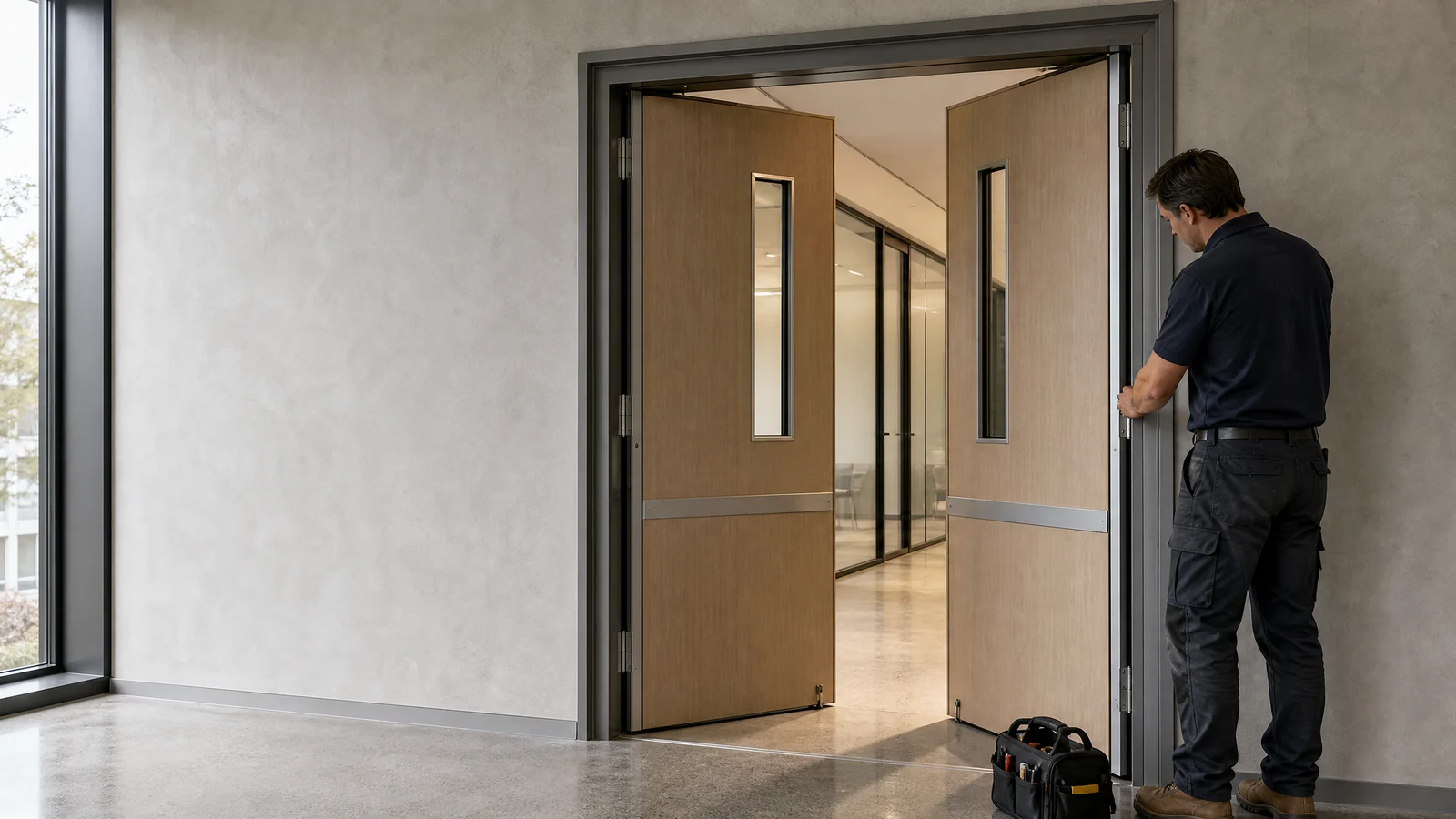
Swing action and leaf count are separate decisions. A single-action leaf opens to one side of its closed position; a double-action leaf can open to either side. A pair of leaves is not automatically double acting. Specify the movement of each leaf on a plan before selecting the frame, hardware or quotation scope.
1. Distinguish four descriptions that buyers often mix
The word “double” can describe the number of leaves, the motion of a leaf or a particular pair arrangement. Use the descriptions below as a starting point, then identify the intended configuration on the project drawing.
| Description | Meaning | Show on the drawing |
|---|---|---|
| Single-action leaf | One leaf swings to one side of its closed position. | Hinge or pivot side, opening arc, stop position and hardware reference. |
| Double-action leaf | One leaf can swing to either side of its closed position. | Both movement paths and the compatible frame, edge and hardware arrangement. |
| Double-leaf opening | Two leaves share an opening; the name alone does not define how either leaf moves. | Each leaf width, action, handing, meeting-edge detail and any active/inactive role. |
| Double-egress pair | A pair of single-acting leaves that swing in opposite directions. | The direction of each leaf, frame arrangement and the project-approved hardware set. |
An active or inactive leaf describes an operating role within a pair; it is not a rule that one leaf must be larger or carry more decoration. Use actual leaf widths and the intended sequence rather than inferring the configuration from a design photograph.
For the broader choice between mechanisms, use the pivot, swing and sliding comparison. This guide focuses on specifying and checking a selected swinging arrangement.
2. Draw the traffic and opening requirements first
Mark the room names, approach directions and required clear opening. Show equipment, furniture, adjacent doors and other obstacles within each movement path. For healthcare or service areas, include the relevant bed, trolley or cart movement in the project review, without assuming that a high-traffic location automatically needs double action.
Have the responsible project team confirm the intended use, visibility, closing and latching needs, access control and applicable escape or accessibility requirements. An opening that admits traffic in two directions does not by itself establish an acceptable emergency-egress arrangement.
For an initial product review, compare interior door systems and hospital door packages. Material, special-action availability and hardware scope must be confirmed for the selected configuration; this guide does not state that every listed product supports double action.
3. Coordinate the leaf, frame and hardware together
Send the actual hardware manufacturer, model and current mounting template. Include leaf width, height, thickness, construction and the proposed weight information needed for hardware selection. Ask who will confirm compatibility, provide reinforcement, prepare the leaf/frame and perform final adjustment.
Double-action hardware is a distinct specification. For example, Allegion’s published guidance for one LCN double-acting closer calls for a cased-open frame. That is a model-specific requirement illustrating why an existing frame cannot be assumed compatible; it is not an instruction to modify every frame or a recommendation of that closer for a VISFURN door.
- Frame and edges: confirm stops, rebates, meeting edges, clearances, seals and any required preparation against the selected system.
- Support and closing: confirm the hinge or pivot arrangement, closer type, fixings, reinforcement and access for adjustment.
- Floor or head interfaces: where concealed hardware is proposed, coordinate the available construction space and maintenance access.
- Other functions: identify locking, access control, vision panels and any operator or hold-open request for separate compatibility and project review.
Use the hardware preparation checklist and handing and swing-direction guide to maintain the same references in the schedule, drawings and quotation.
4. Set inspection references before production release
Agree what will be checked, which document controls acceptance and who records the result. Use the quoted construction, approved sample and relevant product instructions. Do not apply one unverified dimensional tolerance, coating thickness or test routine to all wooden, WPC, composite or metal-framed door packages.
| Review item | Controlling reference | Useful evidence |
|---|---|---|
| Identity and dimensions | Door mark, approved schedule/drawing revision and agreed measurement basis. | Labelled measurements with the relevant acceptance criteria recorded. |
| Construction and finish | Quoted materials, finish/sample approval and any specified supporting documents. | Identified sample comparison and traceable product/document references. |
| Hardware preparation | Approved hardware model, mounting template and reinforcement details. | Preparation positions and included/separately packed components matched to the door marks. |
| Movement and closing | Approved action, opening paths and selected hardware instructions. | An agreed representative assembly or mock-up demonstrating the required movement and interfaces. |
| Required performance | Project criteria and applicable evidence for the exact quoted assembly. | Relevant reports or assessments reviewed within their scope; appearance and an operation video do not establish a rating. |
Record the inspected scope and any limitations. If hardware is supplied separately, say so rather than presenting the leaf as a factory-fitted assembly. For an issue, identify the affected door marks, action owner, revised reference and evidence needed before releasing that scope.
The sample approval checklist covers pre-production release. The pre-shipment inspection guide helps organise the later review. Neither replaces any independent testing or project approval that the selected assembly requires.
5. Include these fields in the quotation brief
- Application, destination and quantities grouped by door mark.
- Plan showing each leaf, its action, handing, opening arcs and required clear opening.
- Leaf/opening dimensions, units, wall thickness and floor/head conditions.
- Construction and finish direction, sample reference and hardware-selection inputs.
- Hinge/pivot, closer, latch/lock, seals and any vision-panel or access-control requirement.
- Supplied components versus preparation only, installation and adjustment responsibilities.
- Specified performance evidence, inspection references and responsible reviewer.
- Packing labels, delivery phases, project dates and unresolved approval items.
A clear RFQ can distinguish a routine single-action interior door from a special-action request before pricing. Keep unconfirmed compatibility and product availability visible until the supplier’s response and project review resolve them.
Buyer questions
Is a swing door always double acting?
No. A single-action leaf swings to one side of its closed position. A double-action leaf can swing to either side. Record the intended action on the plan rather than relying on the words swing door.
Does a double-leaf door mean both leaves swing both ways?
No. Double leaf describes the number of leaves, not their action. Identify the action, opening direction and hardware for each leaf separately.
Is a double-egress pair the same as a double-action door?
No. In a double-egress pair, the two single-acting leaves swing in opposite directions. A double-action leaf can move to either side of the closed position.
Can standard hinges and a closer be reused for a double-action request?
Compatibility must be reviewed for the actual door, frame and selected hardware. Provide the manufacturer, model, mounting template, leaf dimensions and weight; do not assume an existing single-action arrangement can be converted.
What should I send VISFURN for a swing-door quotation?
Send the application, quantities by door mark, a plan showing each leaf and swing arc, opening and wall dimensions, construction and finish direction, hardware scope, destination, project dates and specified performance documents. Special action and hardware availability require confirmation for the selected configuration.
Technical references and scope
References checked 17 October 2026: Allegion’s double-egress definition and model-specific double-acting closer guidance; dormakaba floor-spring accessories; and Allegion’s 2016 explanation of double-acting doors, used for terminology, not current code limits. The references do not establish VISFURN hardware availability, test values or project approval. Use current documents for the actual configuration and market.
Project door inquiry
Send the plan with the required action for each leaf
Include quantities, dimensions, construction and finish direction, hardware references, destination, project timing and the evidence required by your reviewer. VISFURN can review the proposed door package; special action, hardware compatibility, supply scope and commercial terms require confirmation for the selected product.
Request a project door configuration review ↗