
Compare WPC doors by the proposed leaf build-up, fixing zones, finish and complete-set scope. “WPC skin,” “hollow WPC” and “solid WPC” are supplier descriptions; they do not establish equivalent construction, water resistance, acoustic performance or price. Request an identified section and sample before approving repeated openings.

What do WPC skin, hollow and assembled descriptions mean?
Start by asking the supplier to define its terminology. A skin describes a facing component; a hollow description refers to internal voids; an assembled description identifies a way of joining components. These terms answer different questions and should not be treated as a universal quality ranking.
| Supplier wording | Possible meaning to clarify | What to request |
|---|---|---|
| WPC skin door | WPC facings used as part of a built-up leaf with a separate core or supporting structure. | Facing material, core or infill, perimeter construction, joints and the finished edge detail. |
| Extruded hollow WPC door | A WPC profile containing internal cavities, with its own surface and edge configuration. | The offered profile section, actual dimensions, edge closures and hardware fixing provisions. |
| Assembled WPC door | A leaf made by joining specified profiles or panels; the description does not identify every component. | A component list, joint details, panel material and the completed leaf drawing. |
| Solid WPC or solid core | A claim about material or infill that needs a product-specific definition. | A section identifying which components are solid, their material and the evidence relevant to the project. |
Suppliers use these names differently. Do not assign a construction to a VISFURN catalogue image from its colour or groove pattern. Start with the WPC door design collection, then ask which actual construction can be reviewed for the selected opening. This comparison is not a statement that every construction listed here is available from VISFURN.
Compare the same opening before comparing the price
Choose one door mark from the project schedule. Send the same room use, leaf dimensions, finished wall depth, finish reference and hardware requirement with each request. Specify whether the price includes the frame, architraves, hinges, lock, machining, assembly and packing.
Keep differences visible. A leaf with a different finish, a separate frame or omitted hardware is not the same quotation scope even if both lines say “WPC door set.” Use the WPC price-per-set scope guide to compare inclusions after the construction has been identified.
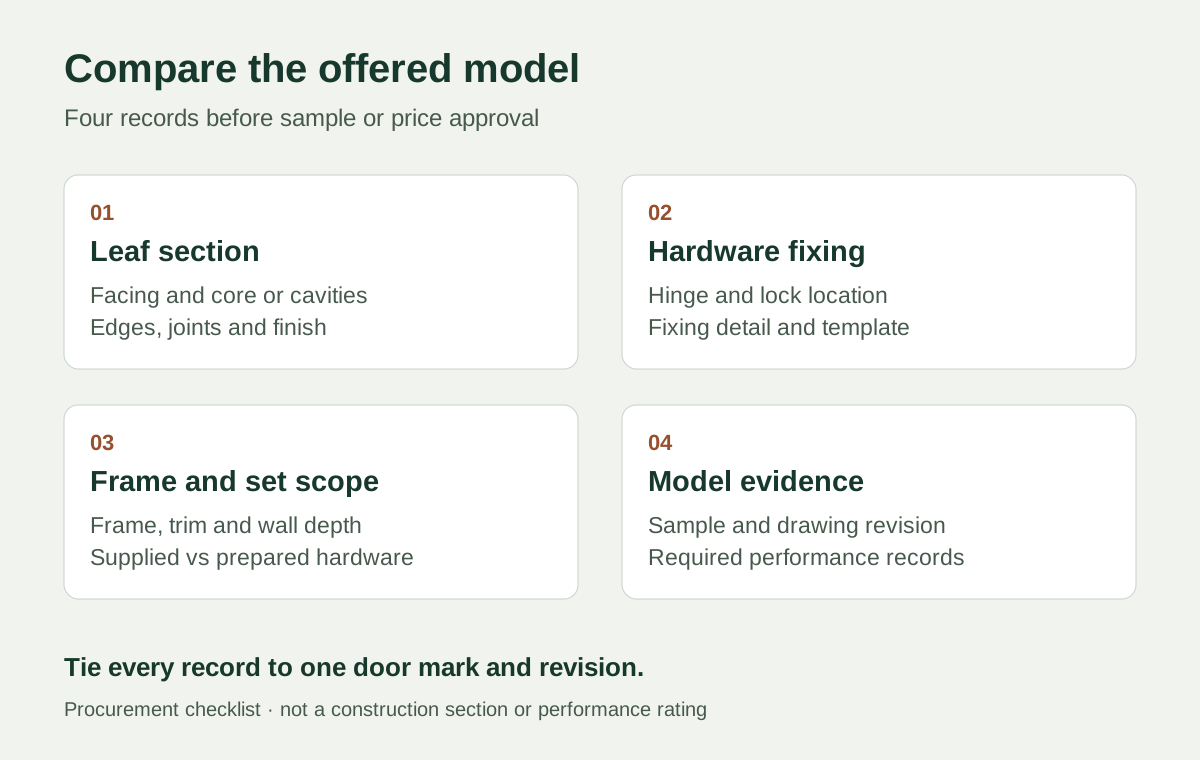
Resolve hinge and lock fixing before machining
Identify the selected hardware model and its preparation drawing. Ask where hinge screws, lock fixings, a closer or any other specified fitting will be anchored in the offered leaf and frame. The reply should identify the fixing detail and any required insert or reinforcement rather than relying on the word “solid.”
For a hollow or built-up proposal, ask how the internal profile and edge construction relate to the proposed cut-outs. Confirm leaf thickness, lock location, handing and the hardware template before repeated machining. Do not approve a screw size, recess depth or hinge load from a generic material comparison.
The WPC bathroom hardware guide covers the rest of the opening. The selected product and hardware documentation must settle the actual fixing method.
Separate leaf construction from wet-area and performance approval
Record whether the room involves humidity, splashes, repeated wet cleaning or another exposure. Request confirmation for the proposed leaf, edges, finish, frame, joints and hardware in that condition. A WPC facing description does not tell the buyer what the rest of the assembly contains.
For required fire, smoke, acoustic or emissions performance, request documentation identifying the offered configuration and the applicable test or approval scope. A hollow leaf is not automatically unsuitable, and a solid description is not evidence of a rating. Have the project's responsible reviewer assess the actual requirements.
Keep cutting permission separate as well. Before ordering a size that needs site alteration, request the model-specific trimming and cut-edge instructions. The door-bottom and floor-clearance guide explains which dimensional references need coordination.
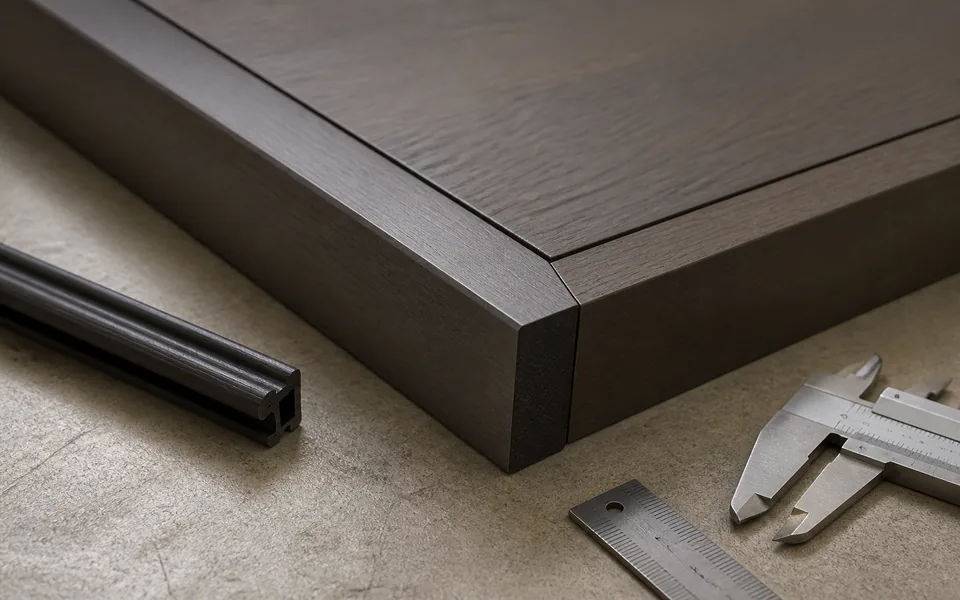
Make the construction traceable to the approved sample
Request a representative section, identified sample and drawing for the quoted model. Record the leaf build-up, finish, edges, frame profile, hardware preparation and revision together. Photographs support the record but do not replace the agreed sample and written specification.
For a mixed apartment or hotel order, group quantities by the approved door type. If a proposed core, profile, finish or fixing detail changes after sampling, review the changed item before releasing the affected openings. Use the WPC sample-to-batch approval guide to control that later approval stage.
Send these details for a construction and quotation review
- Room use, moisture or cleaning exposure, project country and approximate quantity.
- Product link or finish reference, plus any supplier construction description you want to compare.
- Actual leaf size, finished wall depth and frame or trim requirement, if known.
- Hinge, lock and other hardware models or functions, with drawings when available.
- Required performance documents, sample requirements and project dates.
- Destination port or project city, delivery phase and the requested packing or assembly format.
Send the information already available and identify unresolved decisions. The initial enquiry can begin before the final construction is selected; the approved model and dimensions must be confirmed before production release. For alternative material routes, compare the interior door collection.
WPC construction questions from project buyers
Is a WPC skin door the same as an extruded hollow WPC door?
No. A facing used in a built-up leaf and an extruded profile can describe different constructions. Request the offered model's section, core or cavities, edges and fixing details rather than assuming the two labels mean the same product.
Does a solid WPC description prove better acoustic performance?
No. Ask for evidence for the proposed complete door assembly, including the frame, seals, hardware and installation conditions. The material or core label alone does not establish an acoustic result.
Can I select WPC door hinges from a catalogue photograph?
A photograph can show a design direction. Hardware selection and machining need the actual leaf and frame construction, dimensions, fixing provisions and the hardware manufacturer's requirements.
Do all WPC constructions have the same trimming allowance?
Do not assume a common allowance. Confirm permitted edges, limits, machining method and any cut-edge treatment for the selected model before allowing site adjustment.
Can VISFURN quote before my construction specification is final?
Start with the product reference, application, approximate quantity, destination and available dimensions. Ask for a configuration review and identify open decisions. A final quotation and production release need an agreed specification.
WPC project enquiry
Compare an actual door proposal with your schedule
Send your preferred design, approximate quantity, intended rooms and destination. Include the leaf section, frame or hardware documents already available and say which construction questions need review.
Request a WPC construction and quote review →Reference and application notes
Reviewed 23 October 2026. Yingkang's own product catalogue distinguishes skin, hollow and assembly categories. This is an example of supplier terminology, not a universal classification or evidence of VISFURN's range. Floresta's installation and lock-fitting guide, dated 9 September 2026, highlights the relationship among construction, frame alignment and hardware instructions. Neither source establishes a VISFURN specification, warranty or project approval.