
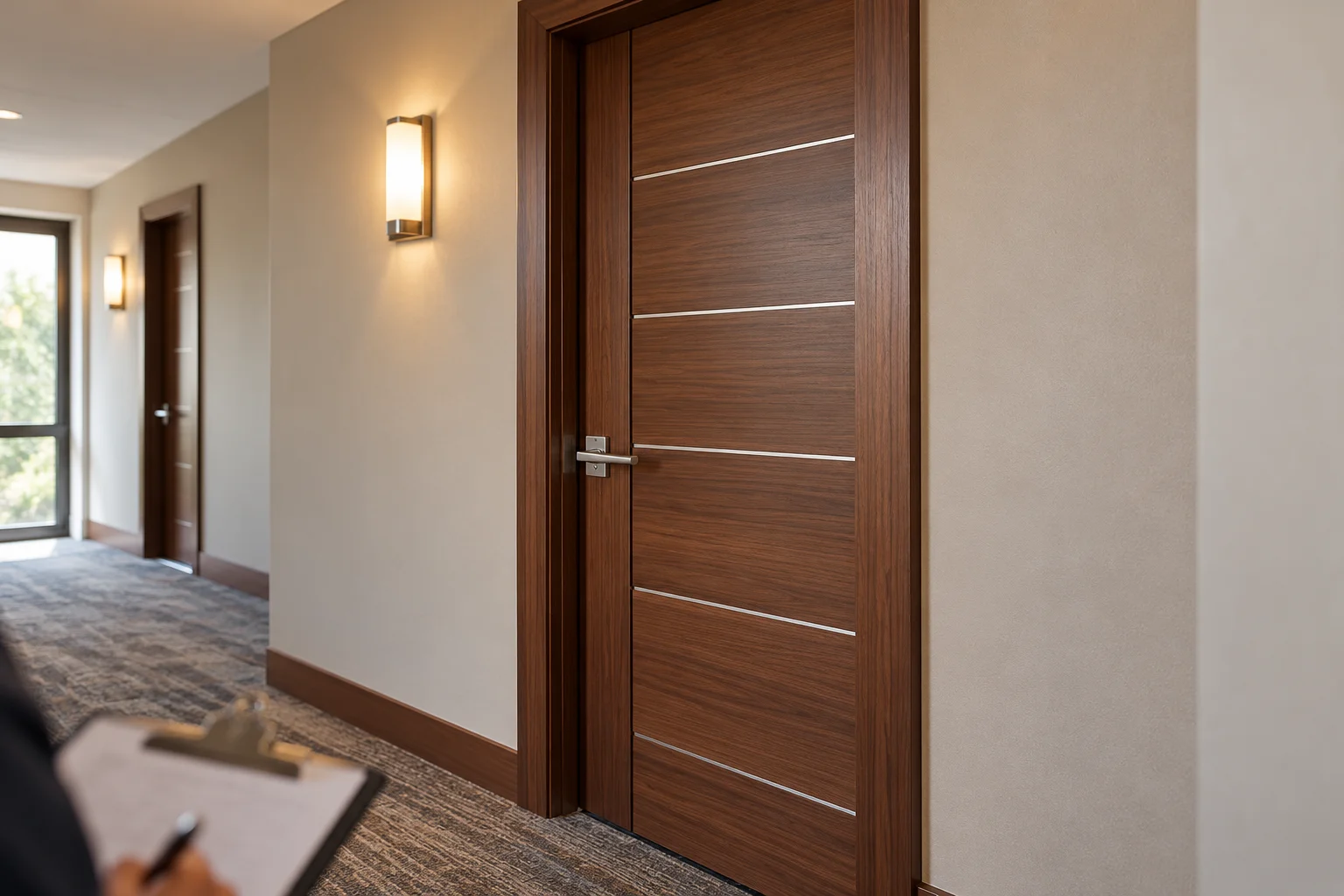
If a veneered project door starts lifting or separating, document the condition before choosing a repair or replacement. Connect each observation to a door ID, product configuration and delivery record, then ask the supplier and the relevant project professional to review it. A photograph can show a visible defect; it cannot establish the cause, warranty responsibility or condition of the complete door assembly.
This guide is for hotel, apartment and commercial-project buyers dealing with a finish issue after delivery. It is not a repair tutorial or a legal claim assessment.
Start with an observation, not a diagnosis
A September 2026 Reddit discussion asks whether an older veneered door can be repaired rather than replaced. The practical uncertainty is relevant to projects too: visible surface damage does not automatically tell a buyer which intervention is appropriate. The discussion is an anecdotal starting point, not a technical specification.
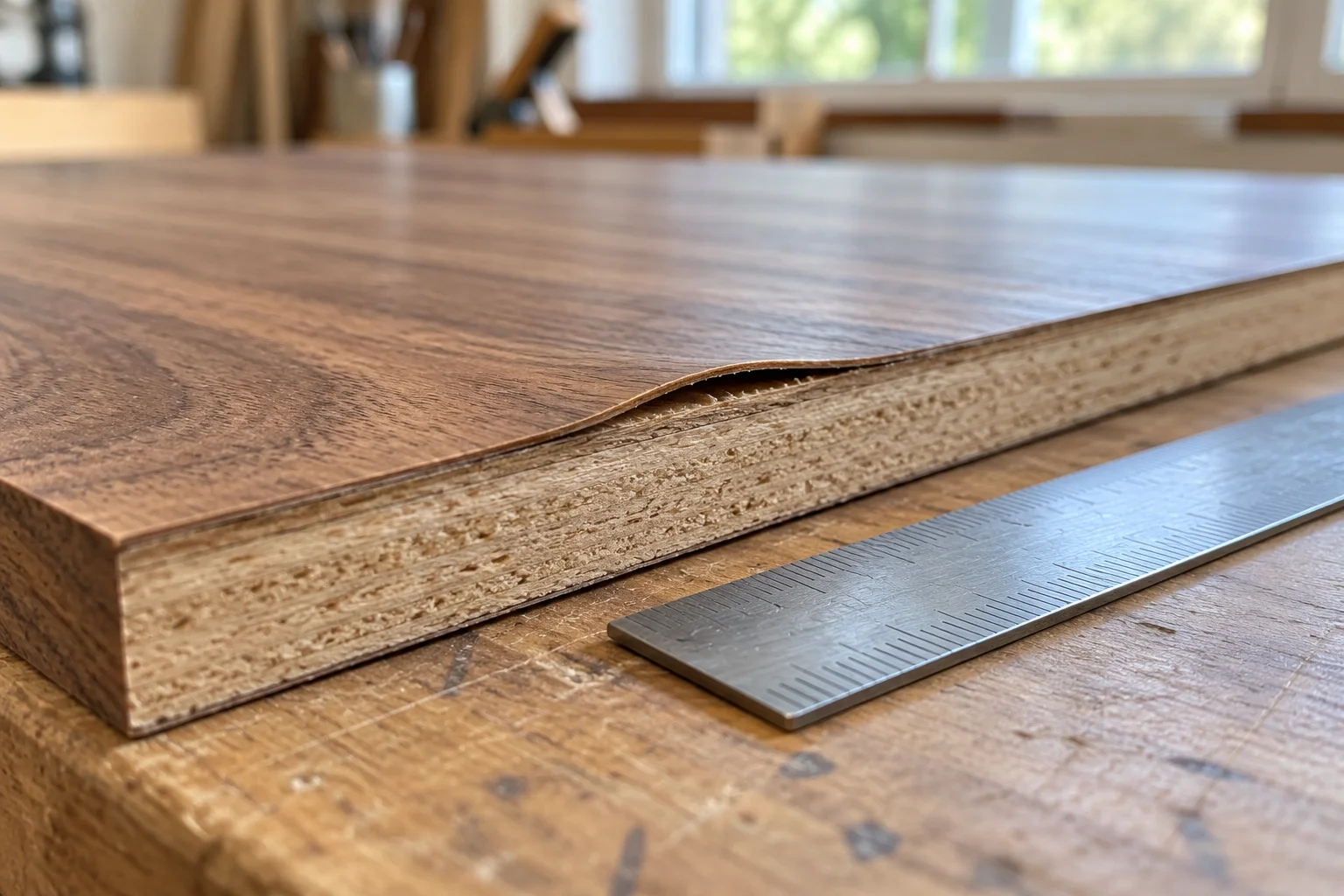
Describe what is visible using neutral language: a lifted edge, a raised area, a crack in the finish, an impact mark or a separation at a joint. Do not group every mark under “delamination.” A scratch and a separating veneer layer raise different review questions.
Record when the issue was first noticed and whether the door was still packed, stored, installed or already in service. If it cannot operate safely, isolate the affected area through the site’s normal safety procedure and obtain an appropriate assessment rather than keeping it in use for the sake of the survey.
Give every affected leaf a traceable identity
Create one inspection entry for each affected door, even when several leaves appear similar. Record the opening number, room or floor, supplier order reference, label information, finish reference and delivery batch where available. Keep unidentified doors marked as unidentified; do not infer their batch from appearance alone.
Photograph the entire opening first. Follow with the full leaf face, the affected area and a close view with a scale placed alongside it. Include both sides where accessible and useful. Keep original files and inspection dates together. Avoid filters, excessive contrast or cropping that removes the surrounding context.
A simple record can keep procurement, installation and supplier teams working from the same facts:
| Record field | What to capture | Why it matters |
|---|---|---|
| Door identity | Opening ID, order and available batch label | Locates the exact supplied item |
| Observed condition | Location, measured extent and visible features | Separates observation from suspected cause |
| Timeline | Delivery, unpacking, installation and first observation | Establishes the sequence for review |
| Supporting images | Overall, detail and identification views | Preserves context and comparability |
| Site history | Storage location, relevant work and available records | Gives the reviewer useful background |
| Current status | In service, isolated or awaiting review | Makes the next action clear |

Preserve relevant site and handling records
Gather the instructions supplied for the actual door, packing photographs, receiving notes and any records of movement between storage areas. Note nearby wet work, reported leaks, cleaning events or unusual exposure without treating any of them as a proven cause.
Manufacturer guidance illustrates why these details matter. Forza’s site conditions and storage guide addresses clean storage, supported stacking, handling damage and protection of veneer from light. Those are useful categories to investigate; its product-specific conditions must not be presented as VISFURN warranty terms or universal acceptance limits.
Where environmental measurements are available, record the location, date, instrument and method. A reading taken today does not reconstruct conditions during earlier storage. Missing records should be identified as missing rather than replaced with estimates.
For planning future deliveries, use the interior door delivery and site-readiness checklist. This incident record has a different purpose: explaining what happened to identifiable doors already supplied.
Check the wider delivery without assuming a batch-wide defect
An isolated finding deserves follow-up, but it does not prove that every door from the order has the same problem. Prepare a review list covering affected items and a sensible comparison group: nearby openings, the same finish or known batch, and doors stored elsewhere.
Agree the inspection extent with the relevant parties. Distinguish doors actually checked from doors merely present in the building. Record “no similar visible condition observed on inspection” rather than making an unlimited claim that a door is defect-free.
Preserve an unused matching reference sample where one exists. Compare under consistent viewing conditions, recognizing that a small approval sample and a full installed leaf serve different purposes. The wood veneer grain-matching guide addresses appearance coordination; it is not a substitute for evaluating a separating surface.
Ask for a written repair-or-replacement decision
Before sanding, injecting adhesive, clamping or covering the area, ask what investigation or intervention is appropriate for the actual construction. Unapproved work may remove useful evidence or change the appearance and configuration being reviewed.
Request a written response identifying the affected door IDs, any further examination needed, the proposed action and who approves it. If a repair is proposed, agree a representative trial, the finish reference, inspection conditions and acceptance process before repeating it across multiple openings.
If replacement is proposed, confirm whether the scope is leaf-only or includes other components. Recheck dimensions, handing, hardware preparation, finish relationship to adjacent doors, site access and room-by-room delivery sequence. Where the opening has fire, smoke, acoustic or other specified performance, obtain configuration-specific professional review before altering it. A cosmetic decision must not be assumed to preserve tested performance.
Close the issue with a usable record
Keep the original report, supplier response, approved action and completion photographs in one record. Record remaining exceptions rather than closing the whole batch because one repair looked satisfactory.
Procurement, technical acceptance and contractual responsibility are separate decisions. A replacement quotation is not an admission of liability, and a visible defect does not by itself establish a legal remedy. Resolve those matters through the applicable contract and qualified advice when necessary.
Buyer questions
Does lifting veneer always require a new door?
No universal answer applies. The construction, extent, intended performance and proposed repair need review. Obtain approval for the actual door rather than copying an online repair method.
Can photographs prove moisture caused the problem?
No. They document appearance. Site records, product information and appropriate examination may be needed to evaluate possible causes.
Should a buyer stop the entire order?
Record the affected scope and agree a proportionate hold or inspection plan with the relevant parties. Do not assume a single observation applies to every supplied door.
Prepare a clear project enquiry
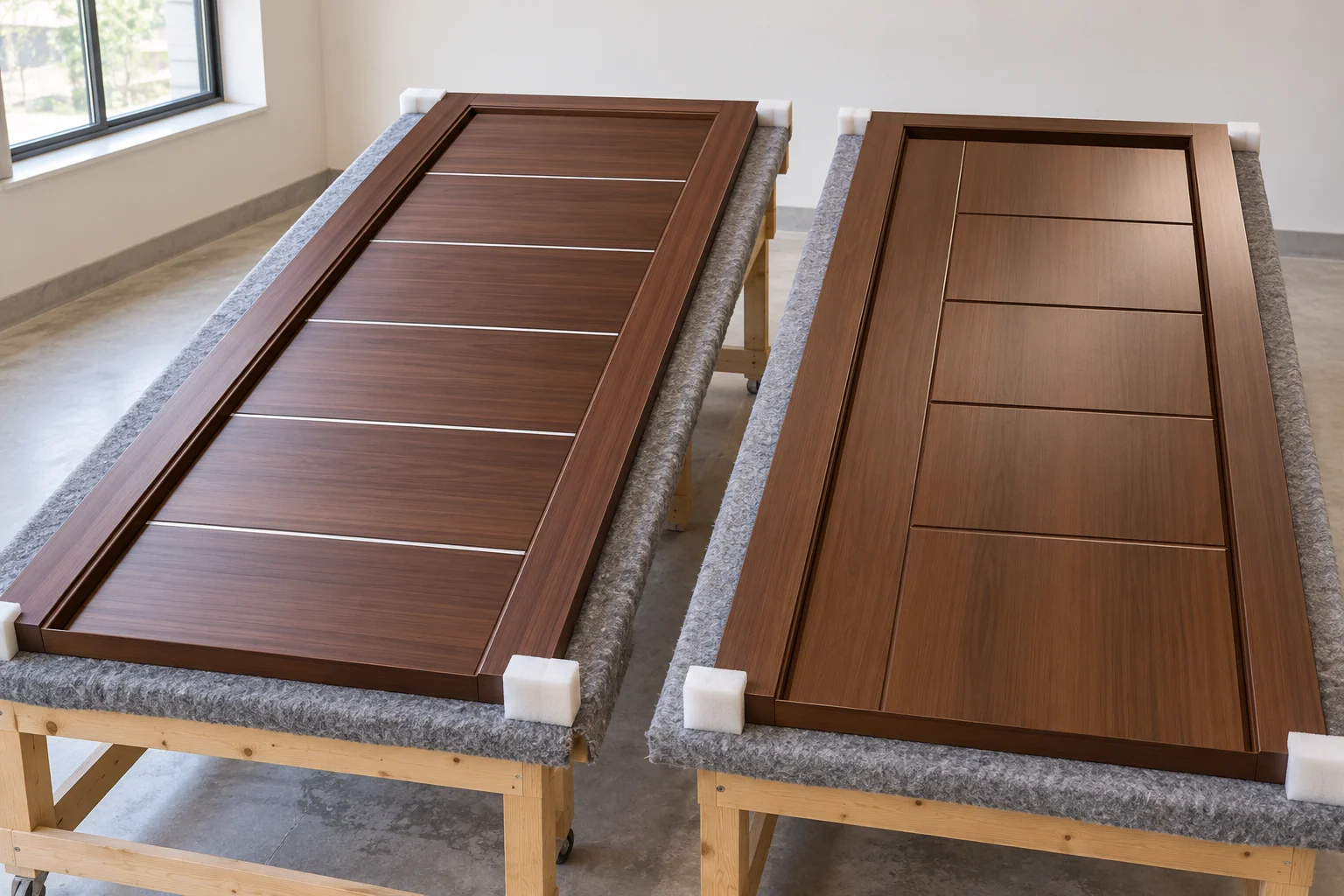
For a new or replacement wooden door package, send VISFURN the opening schedule, photographs, finish reference, quantity and destination. Identify unresolved inspection questions separately from the requested supply scope so the technical review and quotation are not confused.